
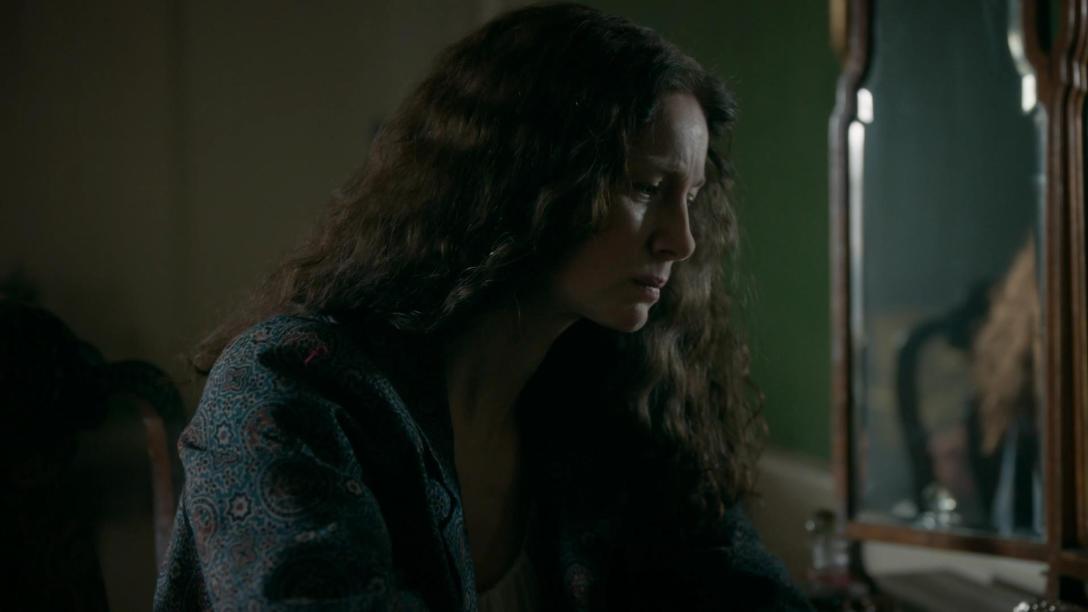
Ah yes, Episode 710. Also known as the hour in which I repeatedly yelled at my screen. Rachel, look behind you! Claire, you’re a terrible spy! It’s Graham McTavish…again! And holy green bean casserole, we finally arrive at Claire Elizabeth Beauchamp Randall Fraser Grey. Grab yourself some turkey leftovers and let’s discuss another great episode.
Warning- Contains spoilers from Outlander Episode 710: Brotherly Love.
“Between stimulus and response there is a space. In that space is our power to choose our response. In our response lies our growth and our freedom.” Viktor Frankl, Man’s Search for Meaning (1946)
Besides the more overt theme of all the different types of brotherly love within this episode- Ian Mòr and Jamie, Jamie and Jenny, Rachel and William (although not by William’s choice), John and Claire (!), John and Henry (John’s brother’s child), and the city of Philadelphia itself (the city’s nickname, born of its Greek translation)-a more subtle theme presented itself: that of the invisible spaces of our lives.
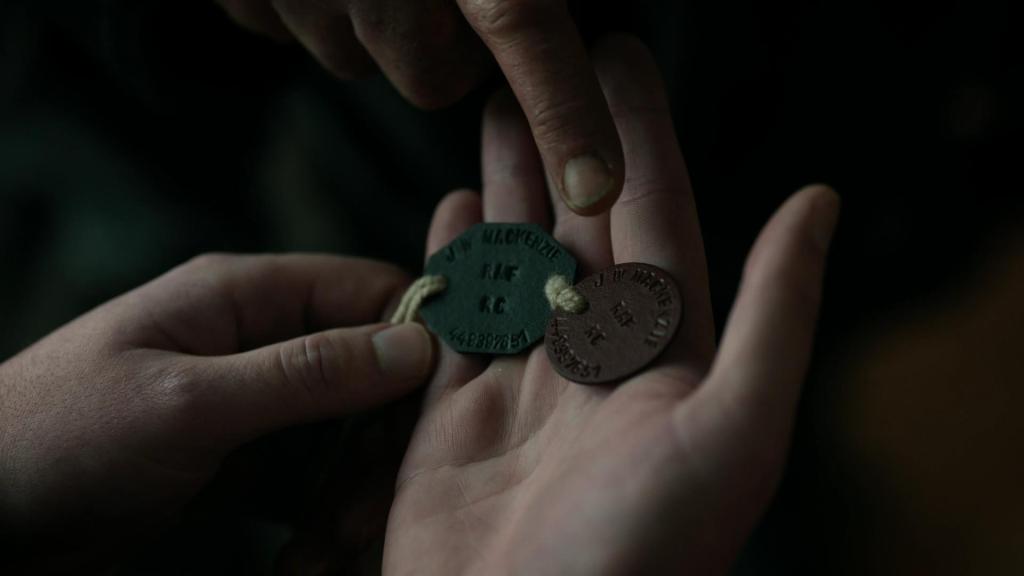
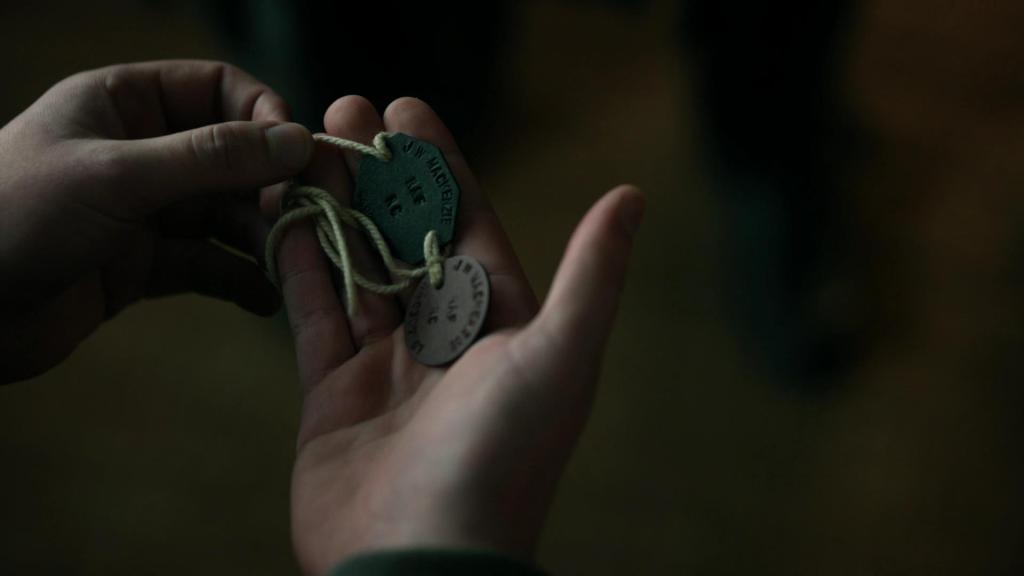
With the discovery of Jerry MacKenzie’s RAF identification tags, World War II loomed just as large this episode as the American Revolution. Viktor Frankl, the Austrian philosopher and Holocaust survivor quoted above, wrote of the space between stimulus and action. He argued that within that space we decide between an almost infinite number of choices, and the decision that we ultimately land on shapes our fate and future. In Man’s Search for Meaning, Frankl wrote of deliberate decisions he made while imprisoned—decisions he argues helped him survive the unsurvivable: appreciating the beauty of a sunset, watching a small bird land on the ground, and having pretend conversations with his wife. In the space between life and despair, Frankl often chose to see beauty and hope.
And so we see in this episode all the invisible spaces that have a profound effect on characters. In the space between living and dying, Ian Mòr says his last words to the two people he loves most. Afterward, Ian’s spirit and memory occupies an invisible space between Jamie and Jenny. A musket ball hides in the invisible space within the intestinal lumen. A letter is dropped in the invisible space of a birdhouse. A war is paused in the space between autumn and spring.
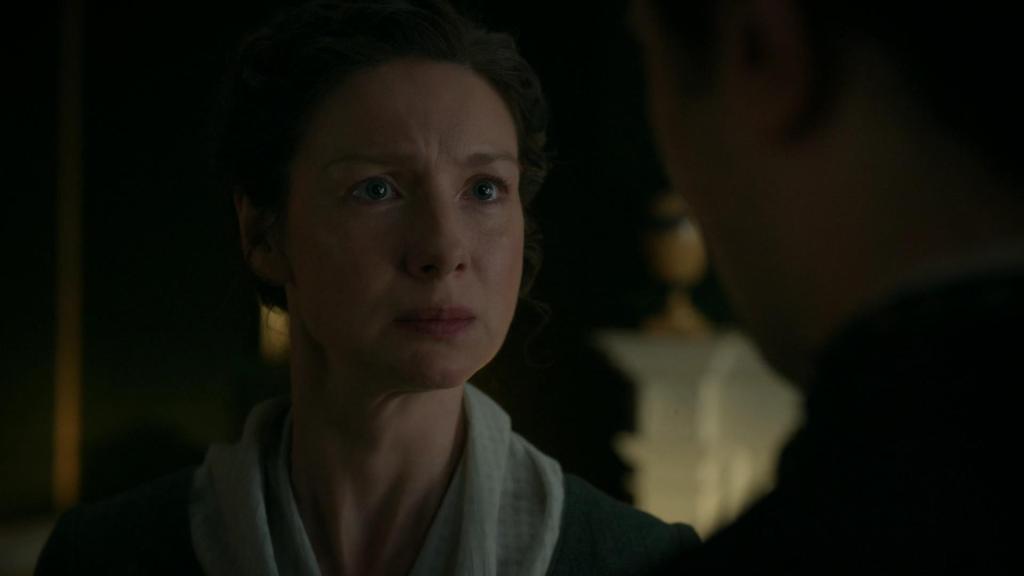
And in the spaces between thoughts and actions, our characters decide their fates: I will love you. I will become a spy. I will marry you. These choices, Frankl argued, is how we survive. And by the end of the episode that is all Claire can hope to do.
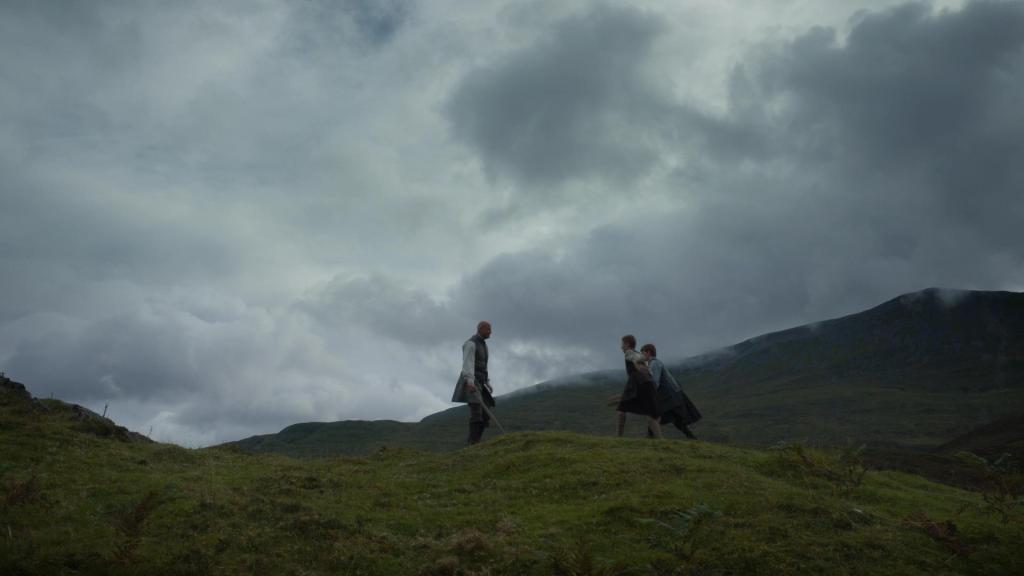
The episode opens with an adorable wee Jamie and Ian learning swordsmanship from Ian’s father, John. “You must fight as one,” John stresses to the boys. Across an ocean and almost sixty years in the future (but within the current events of this episode), George Washington will be imploring the same of his soldiers at Valley Forge.
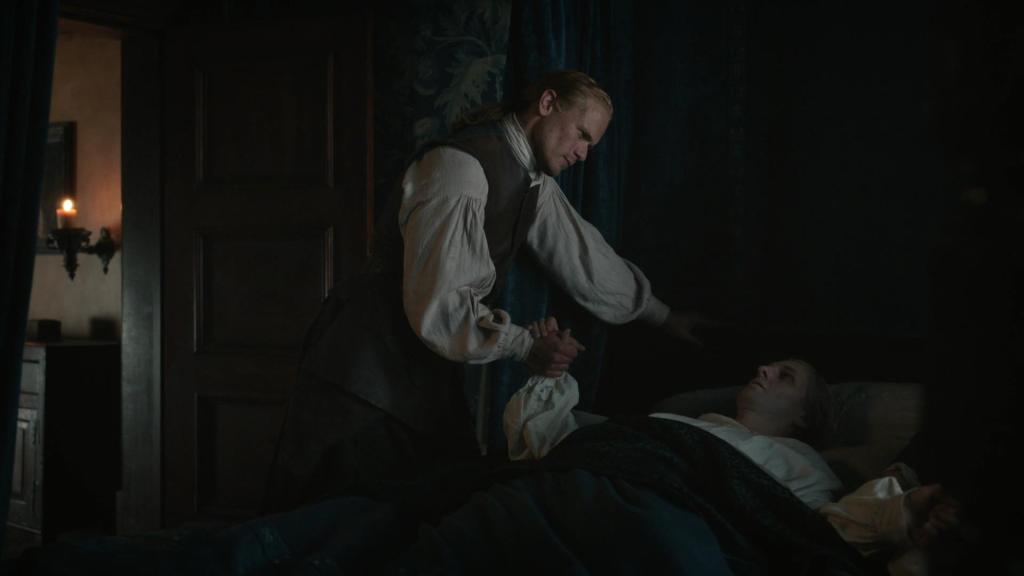
After a touching scene with their grown versions, Ian dies with Jamie on his right and Jenny to his left…how he always was and how he always will be. The simplicity of this moment was quite moving. When we lose a loved one we often feel as though there was never enough time to say all the things we wanted to say. But, if we loved them well, there is often no need to say anything at all.

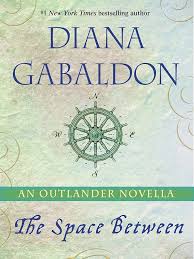
Jamie gives a bit of exposition with Jenny as he digs Ian’s grave, explaining that Michael is accompanying Joan to her convent in France and Jamie intends to visit Paris on his way back to the colonies. Small side note: if you haven’t yet read Gabaldon’s novellas, they really are worth your time, especially the one that focuses on Michael and Joan as they travel to and through France. It’s title? The Space Between.
Back in Philadelphia, Claire comforts Young Ian as he grieves. She comments that people often wait to die until after their next birthday, which I thought was a poignant observation by the writers, as some of our Founding Fathers (Adams, Jefferson), died on July 4 (America’s birthday).
(Note: I mistakingly wrote that Benjamin Franklin died on July 4 in an earlier version. Thank you, readers, for catching my error!)
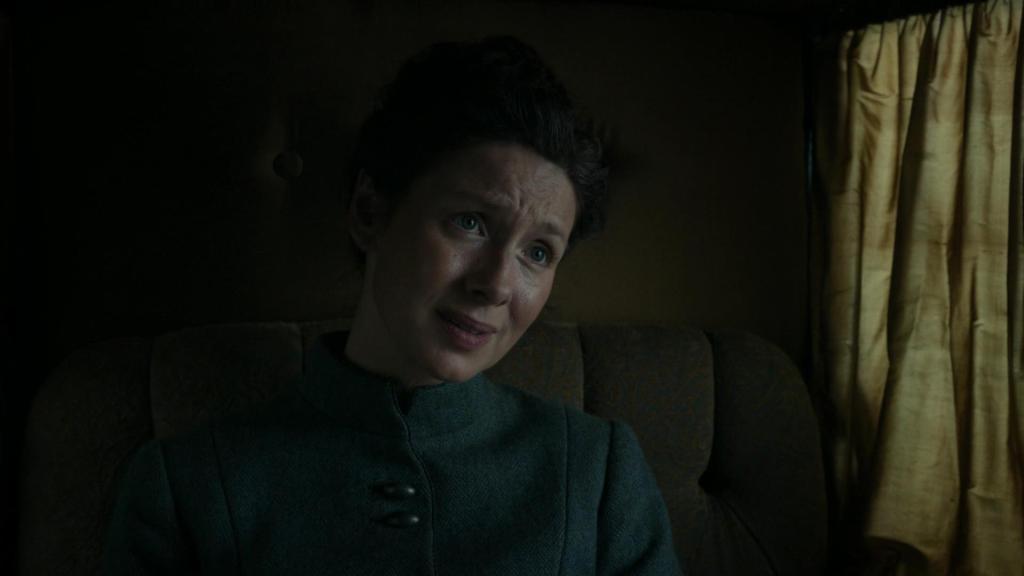
Claire arrives at the home of Mercy Woodcock to tend to Henry Grey. Lord John is also there, and I must admit I did a gleeful happy clap the moment I heard David Berry’s voice.
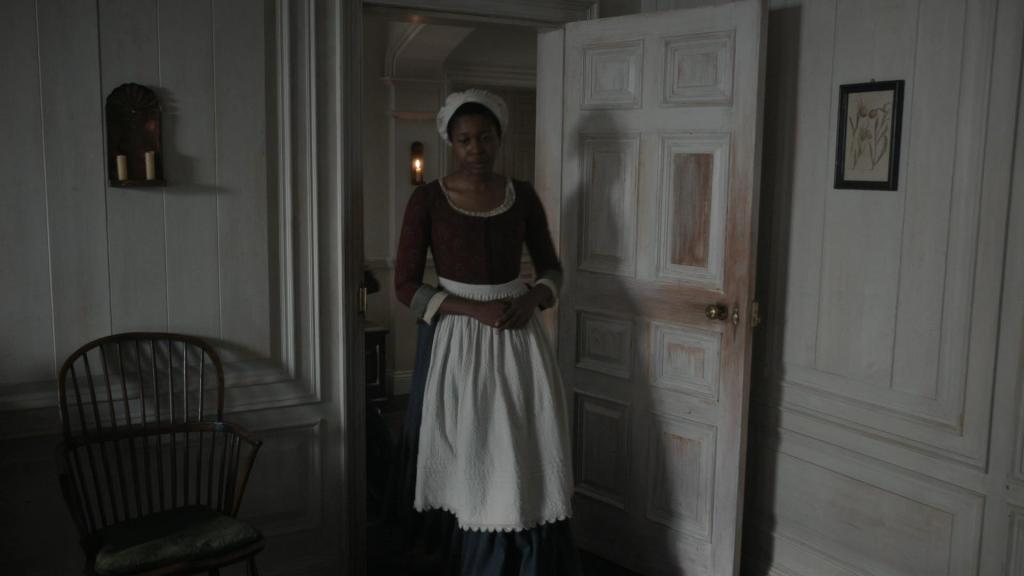
Set design really outdid themselves in this episode. Compare Mercy Woodcock’s home here with that of Lord John’s later in the episode. Woodcock’s home feels distinctly Colonial American—whitewashed walls, relatively sparse furniture, and planked floors. Lord John’s house, by contrast, is darkly hued and richly tapestried, suggesting that most of his furnishings were likely brought over from England.
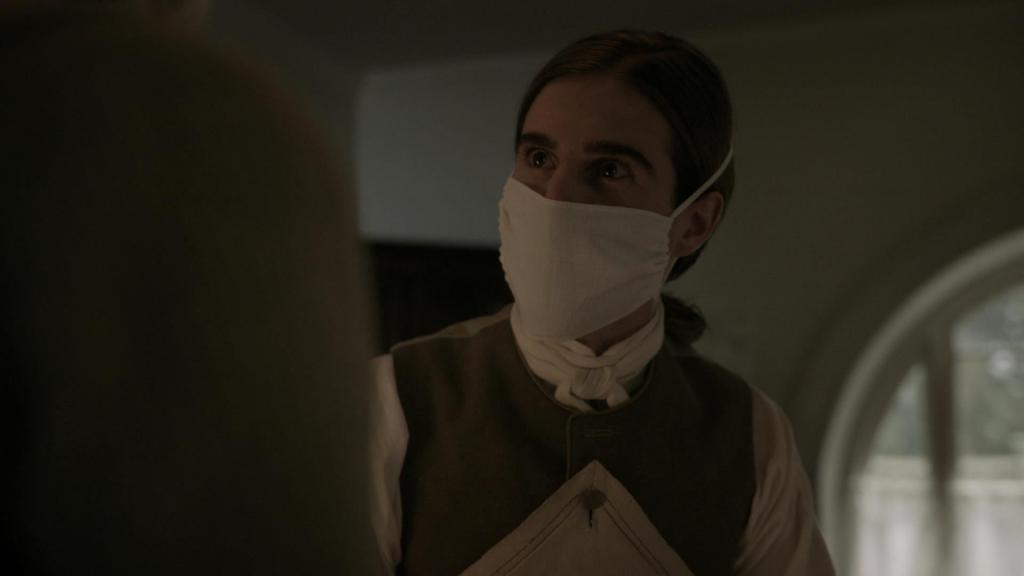
With the use of ether (employed in a more positive use this season), Claire and Denzell are able to retrieve the lost musket ball from Henry’s intestine. We take anesthesia for granted now, but Denzell’s reaction to its seemingly magical abilities reminds us that it really was a game-changer for modern medicine. It is also thematically keeping for this episode—anesthesia is the space between wakefulness and death.
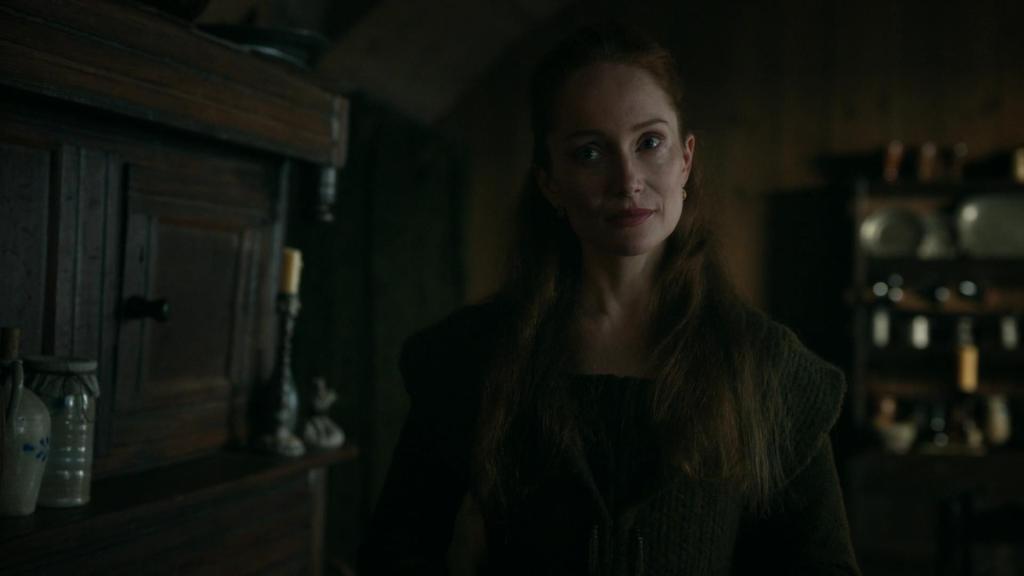
In 1739, Roger, Buck, and Geillis engage in a delicate dance of suspicion and side-eye. Geillis interacts with Roger and Buck in much the same way she did with Claire in Season One—shrewd observation and canny feigned naivety. She likely knows these men are time travelers (I’d wager she also remembers Roger), but she’s too smart to reveal her hand. And, if she had even half a look at them, don’t think she didn’t also recognize the RAF tags for what they were; any child born in the 1940s would have known what they were.
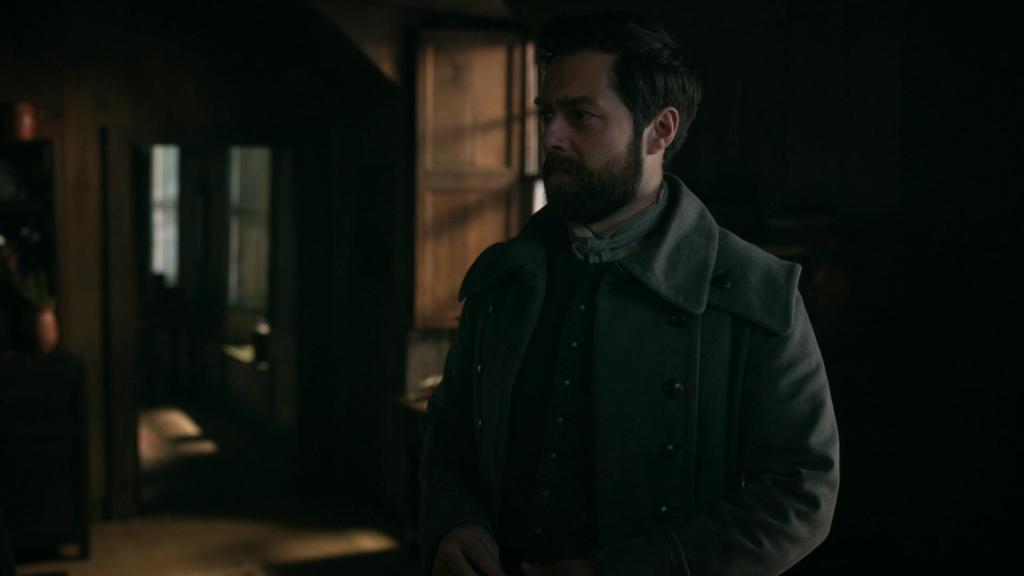
Richard Rankin was phenomenal in this episode; when Dougal MacKenzie shows up you can practically see Roger’s head explode. Each new turn of events since he arrived in this century has been like a cataract of revelation falling on his head. It’s to Rankin’s credit that he shifts from confusion and disbelief to assuredness and joy so readily.
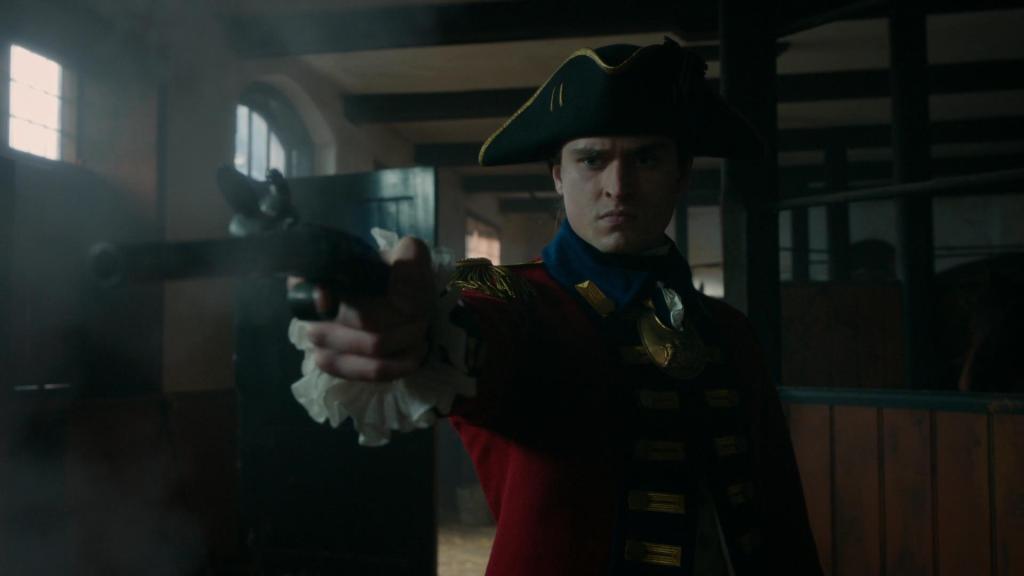
Back (forward?) in Philadelphia, Rachel is reunited with Ian but only after Arch Bug attempts to abduct and murder her as retribution for his wife’s death. Like his adopted father is prone to do, William conveniently arrives in time to save everyone’s life. Indeed, William and Ian are the John and Jamie of this younger generation, taking turns saving one another and becoming more entrenched in each other’s lives with every exchange.
Speaking of becoming more entrenched, Claire is pulled into some Continental espionage when Mercy Woodcock implores her to deliver a letter meant for General Washington. Claire agrees after observing women can generally pass without suspicion. But Claire is infamous for her glass face, and a woman in this time speaking boldly to a uniformed soldier is quite suspicious indeed.
And in the space between her confidence and her life perhaps changing forever, Claire is informed that Jamie’s ship was lost at sea; a copy of the manifest serves as proof of Jamie’s death. Caitriona Balfe has never been as good as she is in this episode, as disbelief, denial, and anger wash over her in a matter of seconds.

So how does one survive such unsurvivable news? We find the spaces in between. Our loved ones are our lifeline, quite literally in Claire’s case as marriage to Lord John ensures she will not be hanged as a spy.
Frankl wrote “A thought transfixed me: for the first time in my life I saw the truth as it is set into song by so many poets…the salvation of man is through love and in love. I understood how a man who has nothing in this world may still know bliss, be it only for a brief moment, in the contemplation of his beloved.” Claire may feel as though she has nothing left in this world, but life goes on in the spaces in between.

The Liberty Bell, shown at the start of the episode, is famously cracked. This was not purposeful—it was never meant to be symbolic—and yet here we are. Within its flaw exists a space. Our Founding Fathers, Benjamin Franklin included, were similarly imperfect and so is the democracy they will help create. But over the course of the next 250 years, between spaces of hope and despair, we get to decide the country we wish to be.
Slàinte.
Screencaps provided by OutlanderOnline.

 Outcandour
Oh my, I have no words, and will be rereading this quite a few times. Love the Victor Frankl references. As always after reading your pieces, I need to do a 3rd rewatch, to look for the finner points that I missed. I look forward to Outcandour almost as much as I do the show. Thank you. It’s good to have you back!
LikeLiked by 1 person
If I understand you correctly, you implied that Benjamin Franklin died on July 4th? But he didn’t. His death date was April 17th (1790). It was both John Adams and Thomas Jefferson who died on July 4th, 1826…. within hours of each other.
LikeLiked by 1 person
Ah you are correct. Mixed up my founding fathers
LikeLike
Thank you for sharing including some of Frankl’s writing. It’s helping to provide some…space to find hope as we try to face the next four years – and beyond – in our country. 🙏
LikeLiked by 1 person
All the comparisons of space and the choices we make were so well done. I struggle with the series and the books at times, but the series is so well done in concept and acting that it helps. I, too, felt a wonderful sigh when Lord Grey showed up…
LikeLiked by 1 person