
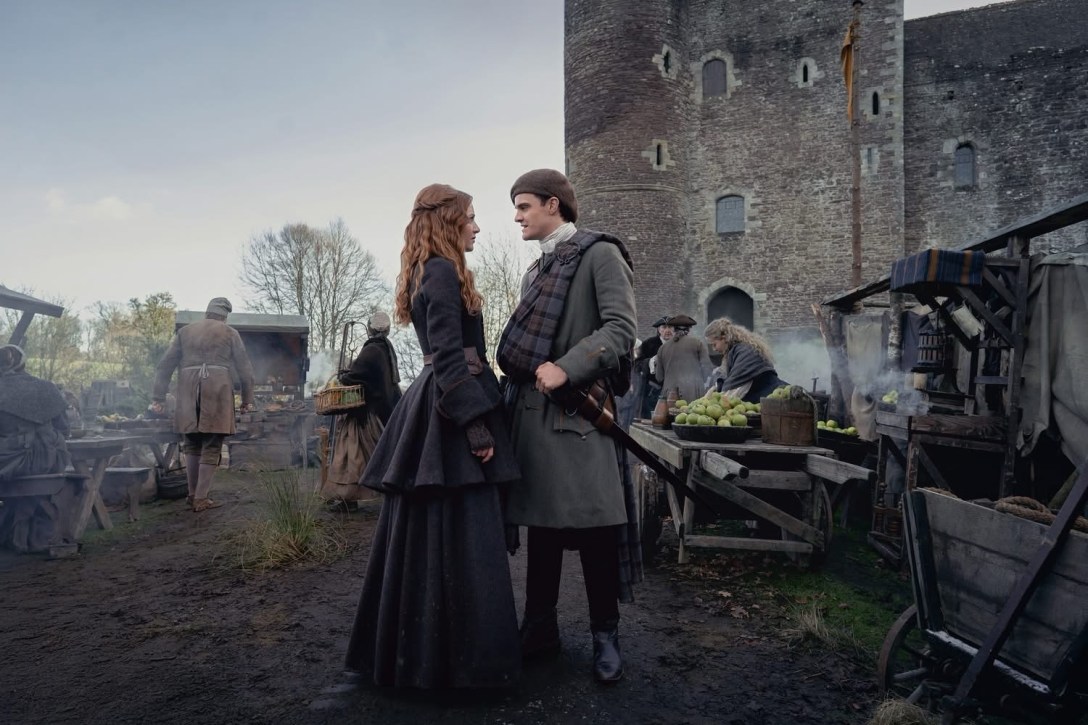
Who refuses to be a pawn in someone else’s chess game? Well, that would be the MacKenzies and Beauchamps. Political machinations are afoot this week! Let’s discuss.
Warning- Contains spoilers from Blood of My Blood Episode 1.3: School of the Moon

If the Outlander universe has taught us anything it is that you best know your Classics. With references to Aristotle, a dual leadership in the tradition of Roman consuls, and a story of clandestine parentage, this episode (like multiple Outlander episodes before it) argues that the personal is political. It’s a tale as old as time. Well, at least as old as Ancient Rome.
First, apologies for such a late recap. Having a new show drop right in the middle of my busy family’s back-to-school is…not ideal. I’ll try my best to get recaps up within a week.
Second, this show continues to be a lot of fun. It knows its audience and knows these characters and it is a welcome diversion against (waves hands around) all this.

This hour, in which thematically nearly all our characters are playing political chess, was another great installment. I know so many people are looking at Ellen’s character to see hints of Jamie, but in truth all I saw in her this episode was Jenny… a woman who is alarmingly smart, knows men, and uses both those traits to her advantage.
The fake-out at the start of this episode was rather well done, leaving me thinking, “Huh. I guess we are here already! Well, it is Outlander!” But, alas, no. Ellen is only dreaming of Brian and is abruptly awoken by Mrs. Fitz and news that the entire Gathering is abuzz with news of Ellen’s betrothal to Malcom Grant.

There are a multitude of people unhappy with this proposal, including Dougal (who was hoping to use Ellen to his own advantage), Brian (who has just fallen in love), Murtagh (whose love is unrequited), and Ellen (who isn’t too keen on being used in any capacity).
Seemingly, the only two people keen on this idea seem to be Colum and Malcolm Grant himself. And while the reason for Malcolm’s happiness is obvious—st this point he seems to genuinely care for Ellen—we learn that Colum’s motivations are driven by a combination of shame, grief, and determination. And what better motivator for such emotions than fear?

It’s funny, Ned tells Henry, that grief feels a lot like fear. But this episode demonstrates that fear underlies so many of our emotions. Jacob MacKenzie is angry with both his sons because he fears neither one is suitable to someday take his place. Colum and Dougal are manipulative and cold because they each fear ceding power. Fear is a poison, Henry wrote in last week’s episode…it sickens everything and turns family against itself. The century is irrelevant.

And, truly, fear is behind most political motivation, is it not? We fear for who our leaders may or not be. We fear for our sense of self and perceived changing identities. We fear for our futures when someone tells us we should. Once again, the political is personal and Outlander has never wavered from that stance.

Indeed, the early rumblings of Dougal’s Jacobite leanings give credence to such a theme. Ultimately the Jacobite risings will be his undoing, but very rarely in the earliest stages of any political movement do we see that such undoings are possible. Like nearly everyone this hour, Dougal is telling others what they wish to hear in order to improve his own standing.

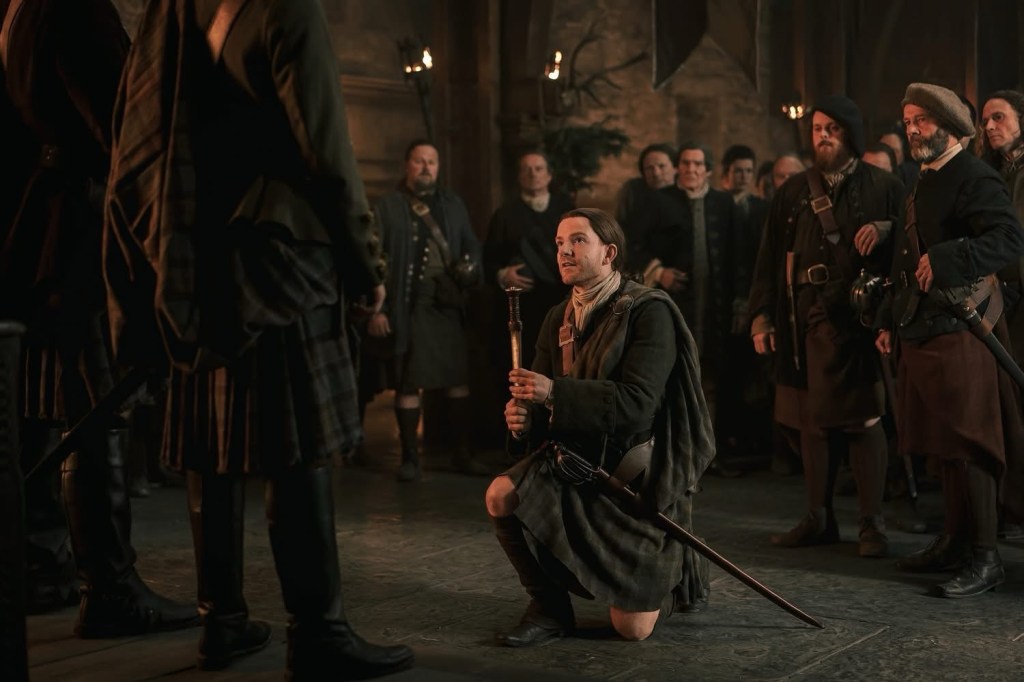
In flashbacks we see Colum humiliated and abused by his father, and this is likely the reason he cannot fathom this same father doing anything except humoring Ellen when it comes to clan decisions. But as anyone who has found themselves in negotiation knows, it is best to be underestimated and then come out swinging. It is she who devises a plan for Colum and Dougal to share clan power, for now consolidating MacKenzie alliances.
On a much smaller scale, political maneuvering is also underway at Castle Leathers. Mistress Porter is no fool and surmises fairly quickly that Julia is pregnant. And while Julia very likely understands the social consequences of pregnancy out of wedlock in her time (lack of access to welfare programs, social ostracism, poverty, etc) here in the early eighteenth century it is an entirely different form of negative outcomes altogether. As Mistress Porter spells out for her while encouraging Julia to induce abortion, Julia and her baby are very likely to find themselves utterly alone and starving for survival.

Julia ultimately comes to this conclusion as well, which is why we see her in the closing minutes present herself to Simon Fraser. A married English woman tying herself to the Fraser clan in an attempt for self-preservation, all while Jacobite players aim to upset the political establishment? We’ve been here before, my friends.

It’s an apt scene with which this episode to end, as it toes in nicely with Ellen’s story. Women have very little actual power in this world…they are promised and traded like property, or thrown aside when they can no longer benefit a man. But Ellen and Julia prove that in these metaphorical chess games that it may be best to be the queen after all…able to move in any direction when an opening arises. In political machinations we tell people what they want to hear, all while whispering to ourselves “checkmate.”
Slàinte.

 Outcandour
So happy to read your analysis of the newest episode! As usual it’s concise, informative, insightful, and entertaining.Thanks very much, looking forward to reading more.
Sent from the all new AOL app for iOS
LikeLiked by 1 person